




What Is the Tridosha Theory in Ayurveda and How Does It Work?

Dr. Gokul

The Tridosha Theory in Ayurveda explains how Vata Pitta Kapha, as three fundamental functional principles, shape the body, mind, digestion, energy, and inner balance. Those looking for an introduction can find a simple explanation of the three doshas and their meaning in everyday life in the Rockholm article Understanding the Three Doshas: Vatha, Pitta & Kapha.
In the Ayurvedic tradition, the idea is not to place people into rigid types. Instead, the theory describes which qualities are naturally more prominent in a person and which factors may disturb this inner order. This makes Ayurveda personal, observational, and strongly focused on the individual.
The Tridosha theory is a central model of Ayurveda. Vata traditionally represents movement and communication, Pitta represents transformation and metabolism, and Kapha represents structure, stability, and lubrication. In Ayurveda, health is understood as a state in which these forces are in harmony with the individual’s constitution.
What Is the Tridosha Theory in Ayurveda?
The Tridosha Theory in Ayurveda, often referred to as the Tridosha concept, describes three doshas that, from an Ayurvedic perspective, influence all physical and mental functions. Official Ayurveda sources in India describe Tridosha as Vata, Pitta, and Kapha, with these three principles being connected to the five elements.
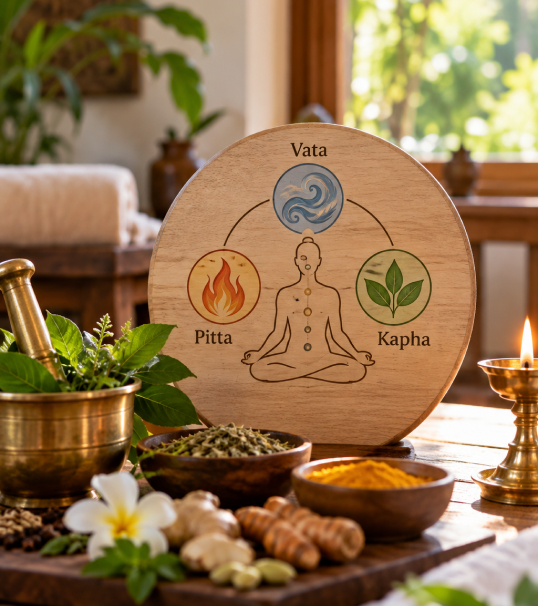
Vata is associated with movement, breathing, circulation, nerve impulses, and communication. Pitta is associated with digestion, transformation, body temperature, and metabolism. Kapha represents building, tissues, joint lubrication, endurance, and stability.
The search terms Ayurveda Tridosha, ayurveda dosha, and ayurveda and doshas essentially address the same question: How does Ayurveda explain individual differences, and why do people respond so differently to food, climate, stress, lack of sleep, or certain routines?
What Are the Three Doshas in Ayurveda?
The three doshas in Ayurveda are Vata, Pitta, and Kapha. Together, they form the basic model Ayurveda uses to describe functional processes. The term doshas ayurveda often appears in international searches, but it generally refers simply to questions about the three doshas and their effects.
Dosha | Traditionally associated with | Typical qualities | Everyday relevance |
Vata | Movement, breathing, circulation, nervous system, communication | Light, dry, mobile, cold, quick | Response to stress, sleep rhythm, digestive movement, creativity |
Pitta | Digestion, metabolism, transformation, body temperature | Warm, sharp, intense, slightly oily, penetrating | Appetite, determination, feeling of warmth, performance focus |
Kapha | Structure, stability, lubrication, nourishment, tissue building | Heavy, cool, soft, stable, slow | Endurance, calmness, joints, immune system, emotional stability |
The term dosha type is often used to describe Vata, Pitta, and Kapha characteristics. However, Ayurveda views these types dynamically. A person may have a Vata-Pitta constitution while currently experiencing a Kapha imbalance, for example due to little movement, heavy food, and sluggish metabolism.
What Is Vata Dosha?
Vata is the principle of movement. In the Ayurvedic understanding, it governs everything that flows, moves, is transmitted, or carries impulses. This includes breathing, intestinal movement, speech, mobility, sensory perception, and mental activity.
A strong Vata constitution is traditionally associated with creativity, quick understanding, mobility, and subtle perception. When Vata becomes imbalanced, Ayurveda often describes dryness, restlessness, changing digestion, cold hands and feet, sleep difficulties, or nervousness. Those who want to learn more can read the Rockholm article Vatha Dosha in Ayurveda.
The search term vata dosha usually refers to this Vata constitution. In practice, however, the individual dosha is not considered alone. Digestion, age, season, habits, environment, and current condition are also taken into account.
What Is Pitta Dosha?
Pitta is the principle of transformation. It is traditionally associated with digestive fire, metabolism, body temperature, eyesight, intelligence, determination, and inner clarity. People with a strong Pitta constitution often appear focused, direct, and performance-oriented.
When Pitta becomes excessive, Ayurveda often describes heat, irritability, a tendency toward inflammation, acid reflux, strong hunger, skin redness, or impatience. The term pitta ayurveda type is often searched by people who want to understand whether they have a Pitta-dominant constitution.
For Pitta, balance usually does not come from applying more pressure, but from cooling, regularity, moderate activity, suitable food, and a calmer daily structure.
What Is Kapha Dosha?
Kapha is the principle of structure, stability, and nourishment. It is associated with tissue building, joint lubrication, physical strength, patience, endurance, and emotional calmness. Kapha provides grounding and stability.
When Kapha becomes imbalanced, Ayurveda often describes sluggishness, heaviness, water retention, congestion, slow digestion, lack of motivation, or strong attachment to habits. Traditionally, balance is supported through lightness, warmth, movement, stimulating routines, and a diet that is not too heavy.
How Does the Tridosha Theory Work?
The Tridosha Theory in Ayurveda works through three central observations: a person’s natural constitution, the current state of the doshas, and the factors that promote balance or imbalance. Ayurveda calls the natural basic constitution Prakriti and the current deviation Vikruti.
A person may naturally have a strong Vata constitution and therefore be more sensitive to travel, cold, lack of sleep, or irregular meals. Another person may have a strong Pitta constitution and react more quickly to heat, competition, spicy food, or overwork. A Kapha-dominant person may need more activation to avoid sluggishness.
The theory is therefore not a rigid label, but a system for understanding patterns. It asks: What is normal for this person? What has changed? Which foods, routines, treatments, and yoga practices could help bring the person closer to their natural balance?
How Do the Three Doshas Affect the Body and Mind?
Ayurveda closely connects the body and mind. Vata influences mobility, nervousness, flow of ideas, and sleep. Pitta influences processing, ambition, ability to handle criticism, appetite, and heat. Kapha influences calmness, patience, attachment, endurance, and building.
For example, a Vata imbalance may appear mentally as overthinking and physically as bloating or disturbed sleep. Pitta may appear as irritability, pressure, or a strong feeling of heat. Kapha may appear as tiredness, heaviness, or holding on to old patterns.
Those searching for Vata Pitta Kapha should therefore not think only about body types. The three doshas also describe how a person thinks, works, digests, recovers, and responds to stress.
What Is the Role of Prakriti in the Tridosha Theory?
Prakriti is the individual’s natural constitution. It describes which doshas are naturally more prominent. According to the Ayurvedic understanding, this constitution remains relatively stable and forms the basis for nutrition, lifestyle, treatment planning, and prevention.
Vikruti, on the other hand, describes the current state. A person with a Pitta Prakriti may currently develop a Vata imbalance, for example after frequent travel, lack of sleep, or emotional stress. This is why a short online test is rarely enough to provide a complete picture.
In Ayurveda, Prakriti is important because treatment is not based only on symptoms, but on the person experiencing those symptoms. Official Ayurvedic information sources also emphasise that Prakriti plays an important role in individual assessment.
If you would like to understand your own constitution better, the Rockholm article Find Your Prakruthi is a helpful next step.
How Does Ayurveda Restore Tridosha Balance?
Ayurveda traditionally supports dosha balance through personalised nutrition, daily routines, sleep hygiene, herbal preparations, oil treatments, breathing practices, yoga, and, where appropriate, cleansing therapies. The suitable approach depends on which dosha is affected, the person’s strength, and whether the situation requires calming, cooling, activation, or nourishment.
The Tridosha Theory in Ayurveda becomes practical here: Vata generally needs regularity and warmth, Pitta needs cooling and relaxation, and Kapha needs lightness and movement. Those who want to understand the philosophical foundation can find a deeper explanation in the Rockholm article Ayurveda Philosophy.
How Can Yoga Support Tridosha Balance?
Yoga can support dosha balance when the practice suits the individual’s constitution. Vata generally benefits from calm, grounding sequences with longer exhalations. Pitta benefits from a moderate pace, cooling breathing, and a practice without performance pressure. Kapha benefits from activating movements, conscious warmth, and more dynamic sequences.
The same principle applies here: not every practice suits every person. An intense, sweat-inducing session may be useful for Kapha, but it may overheat Pitta or exhaust Vata. Ayurveda and yoga work best when they are individually adapted.
Tridosha Theory in Ayurveda: Key Concepts
Concept | Meaning in Ayurveda |
Tridosha | Basic model of Vata, Pitta, and Kapha used to describe body and mind functions |
Prakriti | Natural constitution of an individual |
Vikruti | Current state of dosha imbalance |
Agni | Digestive and transformative capacity |
Balance | A state in which the doshas function in a way that suits the individual’s constitution |
In simple terms, the Tridosha theory provides a traditional framework for understanding individual constitution, physical functions, mental patterns, and everyday responses through Vata, Pitta, and Kapha.
Conclusion
The Tridosha Theory in Ayurveda is more than a model of three body types. It is a practical language for understanding personal patterns, strengths, responses, and imbalances. Ayurveda Tridosha shows why the same food, climate, or yoga practice may affect different people in different ways.
Anyone who wants to use Ayurveda seriously should therefore not rely only on quick type quizzes, but consider their Prakriti, current imbalances, and lifestyle as a whole. This individual perspective is central to the Ayurvedic approach at Rockholm, where traditional principles are connected with the person’s individual needs.
faq's
The Tridosha theory describes Vata, Pitta, and Kapha as three fundamental functional principles. It explains how movement, transformation, and structure interact within the body and mind.
The three doshas are Vata, Pitta, and Kapha. Vata represents movement, Pitta represents metabolism, and Kapha represents stability, building, and lubrication.
The three doshas never work in isolation. Vata moves, Pitta processes, and Kapha stabilises. According to Ayurveda, health occurs when these forces work together in harmony with the individual’s constitution.
Imbalance may result from unsuitable food, stress, climate, season, lack of sleep, lack of movement, overwork, or a routine that does not suit the individual’s constitution.
Ayurveda uses individually adapted nutrition, daily routines, yoga, breathing practices, oil treatments, herbal preparations, and, when needed, professionally guided cleansing therapies.
Prakriti describes a person’s natural doshic constitution. The three doshas show which fundamental qualities are naturally more prominent.
The theory describes wellbeing as a state in which the doshas, digestion, mind, routines, and environment are in harmony with the individual’s constitution.