




What are niyamas and how do they help in everyday life? A simple guide

Mr. Abhijith

Yoga Teacher
Rockholm Resort
Modern everyday life is often fast, loud and full of decisions. Many people feel restless inside. Stress then not only manifests itself in the mind, but also in the body. At the same time, interest in yoga philosophy, meditation and conscious routines is growing. It is less about perfect postures and more about orientation in life. This is precisely where the Niyamas on. They are personal guidelines that combine self-discipline and self-care. Those who practise them calmly and without pressure develop more clarity, inner balance and confidence.
This guide gives a simple explanation of Niyama, without technical language. You will learn how the principles can help you in everyday life.
What are niyamas in yoga philosophy?
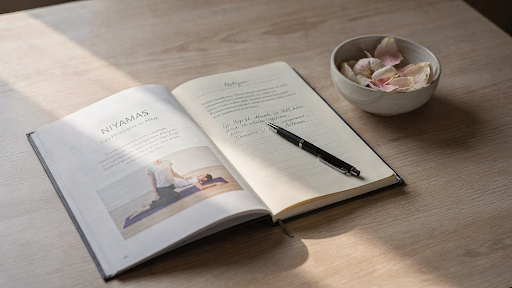
The word niyama comes from Sanskrit and means something like “rule”, “discipline” or “conscious practice”. In the classical yoga tradition, they are part of the eight-limbed path as described in Patanjali’s Yoga Sutra. While the practice often begins with asanas, the philosophy focuses inwards. The importance of the niyamas lies in cultivating a stable inner attitude. They support spiritual growth without being dogmatic.
Also important is the connection between Yamas and Niyamas. Both are regarded as ethical principles. Yamas relate to how we treat others. Niyamas describe how to deal with oneself. Together they form yogic life principles that deepen the yoga lifestyle.
The five niyamas explained simply
The five niyamas are easy to understand if you see them as an invitation. It is not about self-optimization, but about conscious living. Every exercise can start small. Just a few minutes a day are enough. In the following overview you can see the five terms with a clear explanation. This makes the Niyama Yoga philosophy tangible, even without prior knowledge.
Niyama | Meaning | Short explanation |
Shaucha | Purity | Physical and mental clarity through cleanliness and conscious living |
Santosha | Satisfaction | Gratitude and acceptance of the present moment |
Tapas | Discipline | Dedication and perseverance in personal development |
Svadhyaya | Self-study | Self-reflection and personal growth |
Ishvarapranidhana | Devotion | Trust in a higher power and spiritual humility |
How niyamas help in everyday life
In everyday life, these principles act like a compass. They help us to take a step back in difficult moments. Shaucha helps to create order, even mentally. Santosha reminds us of contentment, even if not everything is resolved. Tapas strengthens the ability to persevere without becoming hard. Svadhyaya promotes self-reflection instead of constantly comparing oneself. Ishvarapranidhana gives confidence when the mind cannot find answers.
Many people experience more mindfulness as a result. Stress can also decrease because your actions become more conscious. The spiritual discipline in yoga is not only evident on the mat. It shows itself in conversations, breaks and decisions.
Simple ways to practice niyamas every day
The practice does not have to be complicated. Small, repeatable steps are the most effective. They can Niyamas as a gentle daily reminder instead of strict rules. Rituals that fit in with your life work particularly well. Regularity is important, not intensity.
- 5 minutes of silent breathing in the morning, as an introduction to meditation and yoga
- Gratitude note in the evening, for Santosha and inner balance
- Short tidying up of an area, as Shaucha in everyday life
- One conscious “no” decision per week, as tapas without excessive demands
- A sentence of self-reflection in the journal, as Svadhyaya
- Digital minimalism for an hour to promote mental clarity
If you practise asanas, a short yoga practice is enough. A quiet sun salutation can suffice. Supplement it with a minute of stillness. This makes exercise suitable for everyday life.
Understanding yamas and niyamas in yoga
Many people confuse the terms or equate them. But they complement each other. Yamas are guidelines for dealing with the world. These include non-violence, truthfulness and moderation. Niyamas are the personal side of the practice. They concern routine, self-care and inner focus.
You can see it like this: Yamas protect relationships. Niyamas strengthen the inner space from which relationships arise. Those who cultivate both aspects experience yoga as a way of life. This also fits in with traditional yoga philosophy. It is aimed at conscious living, not just fitness.
Benefits of practicing the niyamas
The effect is often quiet, but noticeable. Many people report that decisions become easier. The inner dialog becomes friendlier. Thoughts circle less. Over time, emotional stability develops. Conflicts also become less sharp because reactions are perceived more consciously.
Typical advantages are
- More inner peace and serenity
- Greater mental clarity and better priorities
- Stronger emotional resilience in stressful phases
- Mindful interaction with body, nutrition and media
- More sense of spiritual growth, without pressure
In combination with Ayurveda wellness practices, holistic well-being can be further enhanced. Kerala is known worldwide for such holistic approaches.
Experience yoga and holistic well-being in Kovalam
Some people like to deepen their practice in an environment that supports silence. Ayurveda Beach Resort Kovalam offers a special coastal atmosphere for this. The view of the sea calms the mind very quickly. Especially on Lighthouse Beach, you often feel a natural deceleration. The local culture is also closely linked to meditation, Ayurveda and yoga traditions, typical of South India.
In this context, it becomes easier to niyamas not only to understand, but also to feel. Those interested in a peaceful retreat will find inspiration at the Kovalam yoga retreat. An Ayurveda retreat in Kerala can also help you establish routines. Some combine both in a yoga and Ayurveda experience. The Rockholm at the Lighthouse Beach Resort is often cited as a tranquil base.
faq's
The five niyamas are shaucha (purity), santosha (contentment), tapas (discipline), svadhyaya (self-study) and ishvarapranidhana (devotion). Together they describe inner exercises for a conscious yoga lifestyle. They are practical, relevant to everyday life and can also be used without a spiritual background.
Niyama means rule or conscious discipline in Sanskrit. In yoga philosophy, it describes personal areas of practice that promote inner clarity. It is about self-reflection, routines and an attitude that supports serenity.
They provide orientation when stress, sensory overload or inner restlessness increase. Many people develop more mindfulness and emotional balance through practicing them. The niyamas also help to examine and gently change habits. In this way, values are not only thought about, but lived in everyday life.
Start small and concrete. A minute of conscious breathing, a sentence of gratitude or a brief moment of order are already practice. A friendly attitude towards yourself is important. Niyamas work through repetition, not perfection. Combine them with meditation and yoga.
Yamas are ethical guidelines for dealing with others, such as non-violence or truthfulness. Niyamas refer to personal discipline and inner direction. Together, they form the moral foundation of yoga philosophy. Yamas protect relationships, niyamas strengthen inner stability.